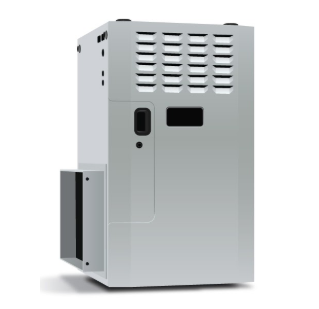
Dealing with a furnace that’s blowing cold air? Yikes! That’s the last thing you want to deal with during a Michigan winter.
But not to worry, while a furnace blowing cold air can be very uncomfortable, it doesn’t necessarily mean you need an expensive or extensive repair.
If your furnace is blowing cold air, here’s what you should do:
- Check your thermostat
- Check your air filter
- Check your condensate line
- Check your pilot light
- Check you exhaust/intake pipe for blockages
- If you’ve tried all of the above, call a technician
Below, we’ll go into each of these steps in more detail, so you can quickly and easily determine why your furnace is blowing cold air and the next steps you should take to fix it.
Rather have a professional take a look at your furnace and repair it? We completely understand. You can learn about the furnace repair services we offer or schedule a furnace repair!
Schedule an appointment today
Step 1: Check your thermostat
If you recently turned your furnace on, your issue could be as simple as the thermostat setting. There are two thermostat settings to look for:
1. The FAN setting
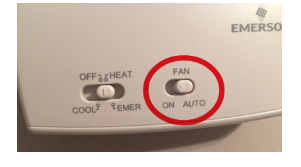
The fan is the part of your furnace that’s responsible for blowing warm air through your ducts and around your home. However, if your fan is set to ON instead of AUTO, it will blow air constantly, even when that air hasn’t been heated. To fix this, ensure that your thermostat is set to AUTO, not ON.
2. The Heat/Cool setting
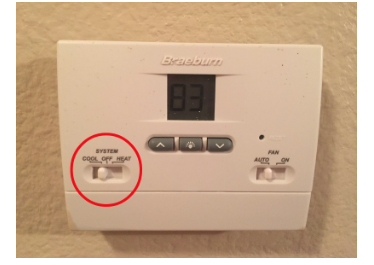
You’ll notice a second setting on your thermostat that has three options: COOL, HEAT and OFF. If your thermostat is accidentally set to COOL or OFF, your furnace won’t produce warm air.
We know this sounds obvious, but as we mentioned before, if you just turned on your heat for the winter, your thermostat could easily be on the wrong setting. To fix this, switch the thermostat setting to HEAT.
Step 2: Check your air filter
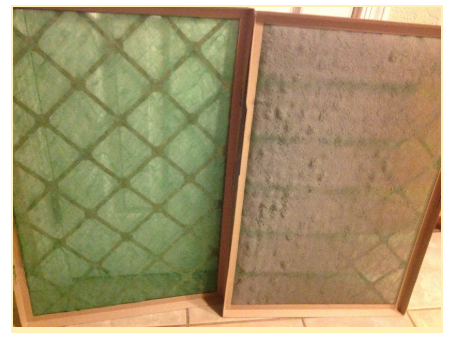
If your thermostat settings weren’t the issue, you should check your air filter. Your air filter works to block debris and contaminants from making their way into your furnace and circulating around your home. However, if you don’t regularly replace your air filter, it can become clogged, which prevents air from making its way to your furnace.Without the right amount of airflow, your heat exchanger (the part of your furnace that actually heats up) can overheat. Your furnace has a safety measure, called a high limit switch, which will turn off the burners if it senses that the heat exchanger is overheating. This protects your home and your system from damage.
To fix this, simply check your air filter and replace it if it’s dirty. As a general rule-of-thumb, you should check your air filter every month and replace it if dirty.
Step 3: Check your condensate line
If you have a high-efficiency furnace, your furnace could be blowing cold air due to a clog somewhere in the condensate line. High-efficiency furnaces produce condensation during the combustion process, and this condensation is drained out of your home via a condensation drain.However, if there is a clog somewhere along this line, it could cause your system to get backed up. If it gets too backed up, your furnace has a safety feature called an overflow kill switch, that will shut your system off to prevent water damage.
Typically, clogs in the condensate line are due to:
- Mold
- Ice
- Debris (dust, dirt, etc.)
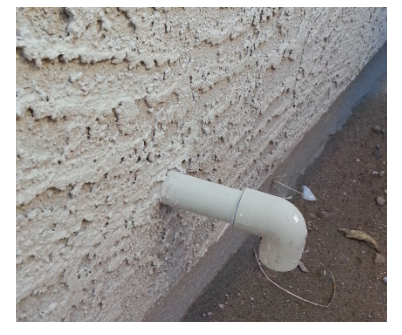
Step 1: Locate your condensate drain. It will usually be a white PVC pipe and will look something like this:
Step 2: Attach a shop vac to the end of the condensate drain. Make this connection as airtight as possible by gripping tightly where the drain line and shop vac meet.
Step 3: Turn the vacuum on for 1–2 minutes. Notice any debris in your shop vac? If not (or if you’re still experiencing cold air blowing from your furnace), you should call a professional. You may have a clog higher up in the system that will require a professional to remove.
Step 4: Check your pilot light
If you have an older, gas furnace, your furnace may be blowing cold air because the pilot light is out.If the pilot light isn’t lit, your furnace’s burners won’t light, which means your furnace won’t produce warm air.
While you can relight your pilot light on your own, it’s a bit of a hassle. So, if you’ve tried all of the above and you know that this is your problem, we’d suggest reaching out to a technician to relight your pilot light if necessary.
Step 5: Check your intake/exhaust pipe
If you have a high-efficiency gas furnace, it uses a set of pipes called the “intake pipe” (responsible for pulling in fresh, outdoor air) and the “exhaust pipe” (responsible for pushing exhaust fumes outside) to operate properly.
Sometimes one or both of these pipes can become blocked by snow, grills, trees, bushes, etc, which suffocates the system, much like the condensate pipe being clogged or blocked.
To check your exhaust/intake pipes, follow the steps below:
- Locate your furnace inside your home.
- Look for a set of white PVC pipes that connect to the furnace and follow those pipes to the outside of your home. The exhaust pipe should be pointing up and the intake pipe should be pointing down.
- Check the opening of each pipe for blockages and remove any debris.
- Make sure there is a clearance of at least 5 feet around both pipes.
Step 6: Call a technician
If you’ve checked all of the above and are still having issues with your furnace blowing cold air, you may have an issue with your system that a technician will need to fix, like:
- An issue with your gas supply
- Duct problems (leaks & holes)
- An issue with your thermocouple
- Broken condensate pump
- And more
Schedule an appointment today




Follow us on our social networks for special updates and offers!